

When analysing a packed weekend fixture list across the English Premier League, Serie A, or the FKF Premier League, most punters gravitate toward the classic three-way (1X2) match winner market. Yet as tactical pressing systems and expected goals (xG) data have matured, sharp analysts increasingly bypass match-winner markets altogether—focusing instead on total goal lines (Over/Under 2.5), after-tax accumulator math, and instant-settlement formats that eliminate 90-minute stoppage-time heartbreak.
Here is how modern football bettors combine tactical match-state reading with precise payout mathematics to protect their bottom line.
1. Why Tactical Match State Matters More Than League Averages in Over 2.5 Markets
On paper, an Over 2.5 goals bet is straightforward: the fixture needs at least three combined goals (2-1, 3-0, 2-2, or higher) within regular 90-minute play plus injury time. Because there is no half-goal push on a 2.5 line, your ticket settles cleanly as a win or a loss—and unlike Both Teams to Score (BTTS), a dominant 3-0 home win cashes an Over 2.5 ticket comfortably.
However, the most common mistake recreational punters make is backing Over 2.5 simply because both teams scored three goals the previous weekend. Recent scorelines are noisy; tactical match states and transition pace are what actually drive three-goal fixtures:
- High Line vs. Direct Counter-Attack: A heavy favourite that pushes its full-backs high up the pitch against a fast counter-attacking underdog creates high-probability chances at both ends.
- Early Goal Sensitivity: When a match features two teams that desperately need three points, an opening goal inside the first 25 minutes forces the trailing side to abandon its low block, opening up space for a second and third goal.
- Implied Odds Thresholds: Decimal odds of
1.90on Over 2.5 imply roughly a 52.6% probability before bookmaker margin. If your tactical read and head-to-headxGdata point closer to 60%, you hold a genuine mathematical edge.
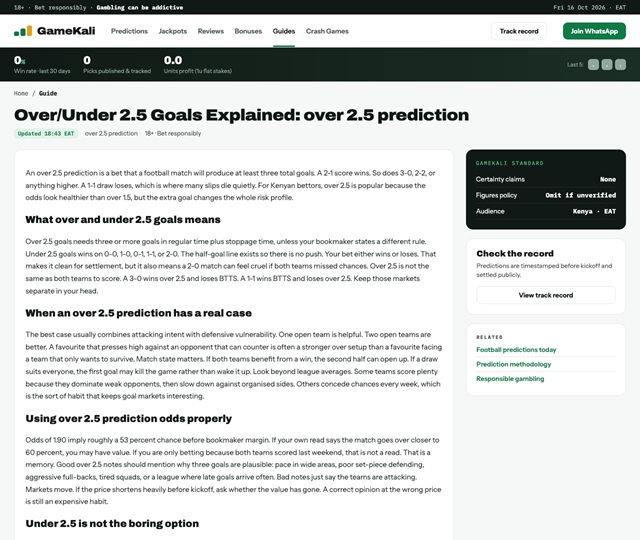
GameKali tactical breakdown of Over/Under 2.5 goals markets, comparing BTTS overlaps, match states, and implied probability pricing.
Before locking in goal-line selections on your weekend coupon, reviewing a structured framework for evaluating Over 2.5 goals probabilities helps you distinguish between genuinely open tactical matchups and overpriced public favourites where Under 2.5 actually holds the sharper value.
2. The Real Math Behind Multibets: Factoring in Net Take-Home Payouts
Once you have shortlisted three or four strong match reads, the next hurdle is calculating what your slip actually pays out after compounding odds and statutory deductions.
When stacking multiple legs into a treble or four-fold accumulator, doing mental arithmetic on your phone often hides two critical numbers:
- True Combined Odds: Multiplying
1.55 × 1.80 × 2.10yields combined decimal odds of 5.86 (an implied hit rate of roughly 17.06% before margin). - Net Take-Home vs. Gross Payout: In regulated East African markets like Kenya, a 20% withholding tax on net winnings significantly alters your real risk-to-reward ratio.
Sokalytics interactive Multibet Accumulator Calculator displaying combined odds (5.86), gross payout (KSh 585.90), 20% withholding tax (KSh 97.18), and net take-home (KSh 488.72).
Running your numbers through a free multibet accumulator and withholding tax calculator before placing a bet shows your exact net M-Pesa take-home in seconds. Seeing how each additional leg affects both your win probability and after-tax return prevents the common trap of adding a low-odds fourth leg that barely moves the net payout while introducing unnecessary injury-time risk.
3. Avoiding 94th-Minute VAR Heartbreak With Instant-Settlement Formats
Every seasoned football punter knows the frustration of watching eight legs of a weekend multibet sail through, only for a controversial 94th-minute VAR penalty or a postponed fixture to ruin the entire ticket after six hours of waiting.
That settlement delay—and the emotional fatigue that comes with it—explains why many analytical bettors now split their weekly entertainment budget into two separate buckets:
- Pre-Match Value Slips (2–3 legs max): Targeted at high-value Over/Under 2.5 and Draw No Bet markets.
- Instant-Settlement Micro-Sessions: Fast, provably fair multiplier wheels, crash games (Aviator, Paka Kumi), and high-RTP spin titles that resolve in 5 to 15 seconds rather than 90 minutes.
GameNoma analysis of why football punters use instant-settlement games and rapid M-Pesa rails to avoid 90-minute VAR variance.
Unlike a 10-leg football accumulator where bookmaker margins compound past 30%, exploring instant-settlement casino games for football bettors introduces you to single-event rounds with transparent 96.5%–97% Return-to-Player (RTP) math, micro-stakes starting at KSh 10, and immediate Safaricom M-Pesa payouts—with zero referee errors or weather postponements in the equation.
Final Takeaway
Smarter match analysis in 2026 isn’t about stacking 15 heavy favourites onto a single slip and hoping for a miracle. By pricing Over/Under 2.5 goal markets around tactical pace rather than last week’s scoreline, checking your true after-tax payout on a multibet calculator before staking, and using transparent instant-settlement games when the fixture list offers low value, you keep complete control over both your odds and your bankroll.
